Heavy Timber Craft: Timeless Craftsmanship.
Nearly 40 percent of the most historic wooden buildings in the U.S. use traditional joinery, not nails. That statistic underscores the resilience of timber framing.
This guide shows how timber framing is a practical, long-lasting building method. It leverages sustainable materials and classic joinery creates framing timber for homes, agricultural buildings, pavilions, and commercial projects.
We’ll cover timber frame construction methods, ranging from heritage mortise-and-tenon to new CNC and SIP techniques. We outline the background, techniques, species and components, design, and construction phases. We also describe modern upgrades that enhance energy performance and durability.
If you’re considering timber frame design for a new home or a commercial site, this guide is for you. It’s a Timber Framing 101 that helps with planning and ensures lasting craftsmanship.
Key Takeaways
- Timber framing construction combines sustainable materials with proven joinery for long-lived structures.
- Timber frame building techniques range from traditional mortise-and-tenon to modern CNC-assisted methods.
- Timber frame architecture suits residential, agricultural, and commercial applications.
- SIPs and continuous insulation improve efficiency while preserving style.
- A practical, U.S.-oriented overview of history, materials, design, and build steps.
Timber Framing Defined
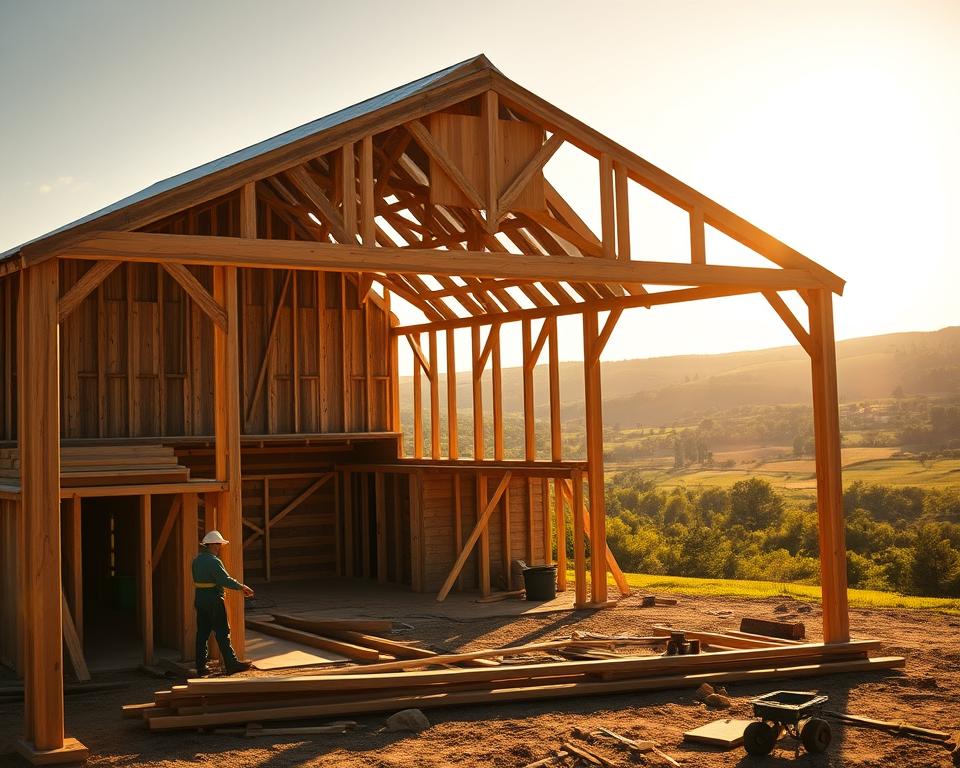
Timber framing employs big, heavy timbers joined with wooden pegs. It’s different from stick-built framing, which uses smaller lumber like 2x4s. The result is a structural skeleton carrying roofs and floors.
It’s renowned for its long-lasting frames, thanks to precise joinery and craftsmanship. Fewer interior walls and generous open spans are common. It’s valued in both old and new buildings.
How It Works
Fundamentally, timbers are arranged into a rational frame. Wooden pegs lock mortise-and-tenon joints for stability. Designers plan it so that beams and posts carry the weight, making fewer walls needed.
What You’ll Notice
Expect oversized members and expressed structure. Vaulted interiors and articulated trusses are common. Frames frequently feature 8×8 or larger sections for presence and capacity.
These frames span wide spaces with trusses and post-and-beam layouts. Hybrid steel connectors can complement tradition. Tight joinery plus pegs delivers strength with controlled movement.
Enduring Appeal
Timber framing is strong, lasts long, and looks great. Centuries-old frames testify to durability. Wood is also a sustainable choice when harvested right.
More people are interested in timber framing for its eco-friendliness and beauty. Practitioners combine heritage joinery and modern analysis. Thus they meet current codes and preserve tradition.
History and Origins of Traditional Timber Framing
Its lineage crosses continents and millennia. Roman evidence reveals refined joinery. Builders in Egypt and China also used similar methods in temples and homes, showing the origins go back far before the Common Era.
In medieval Europe, homes, halls, and barns were built with large oak and ash timbers. Skilled carpenters in England, Germany, and Scandinavia made precise joints and pegged frames. These frames have lasted for hundreds of years, showing the history of timber framing.
The craft developed rituals and marks. The topping-out ceremony, starting around 700 AD in Scandinavia, celebrated roof completion with speeches and toasts. Layout and identity marks traced guild lines and families.
Sacred structures highlight endurance. Jokhang (7th c., Lhasa) stands among the oldest surviving frames. They unite cultural meaning with structural longevity.
Industry transformed building. New sawmills and mass-produced nails led to balloon and platform framing. These methods were cheaper and faster, making timber framing less common in homes.
The 1970s sparked a revival. This was due to environmental concerns and a love for craftsmanship. Today, timber framing is used in specialty homes, restorations, and high-end projects. Modern designers mix old joinery with new engineering to keep the tradition alive.
The story of timber framing spans ancient ingenuity, medieval mastery, ritual practice, and modern resurgence. Every period contributed techniques and ideals sustaining its appeal.
Modern Revival and Innovations in Timber Frame Construction
In the 1970s, people wanted simpler, more natural homes. Heavy timber returned to the spotlight. It also brought new methods that meet today’s energy and durability needs.
The 1970s saw a surge in environmental concern and a desire to revive traditional crafts. Sustainable timber framing became popular because wood absorbs carbon and is renewable. It secured a place in green-building strategies.
Digital Craft Meets Tradition
New tools like CNC routers and CAD software have transformed timber framing. They allow for precise cuts while keeping traditional joinery shapes. Prefabrication and kits reduce on-site work and waste. Timber + steel/engineered parts offers speed and flexibility.
Performance upgrades and energy efficiency
Engineered members and better insulation stabilize frames. These changes reduce movement and increase durability. With upgraded envelopes and HVAC, efficiency and tradition align.
| Area | Conventional Practice | Current Approach |
|---|---|---|
| Joint Accuracy | Hand-cut mortise and tenon | CNC fabrication with QC |
| Envelope Efficiency | Minimal insulation between posts | SIPs/continuous insulation with high R |
| Erection Speed | On-site full assembly | Prefabricated frames and kits for fast raising |
| Connections | Wood-only joints | Hybrid connections using steel plates or bolts |
| Moisture Strategy | Traditional ventilation strategies | Engineered drying, airtight envelopes, and mechanical ventilation |
Sustainable timber framing now combines old craft with modern engineering. This approach creates resilient, efficient buildings. They meet today’s codes and expectations while honoring timber framing’s traditions.
Types of Timber Frame Buildings and Applications
A versatile system across building types. It’s chosen for its beauty, large spans, and clear structure. Below are typical uses and distinguishing traits.
Residential Use
Expect open plans, exposed members, and lofty ceilings. Generous glazing admits abundant daylight. Interiors feel bright, warm, and inviting.
Builders mix timber framing with SIPs or regular walls to meet energy standards. People love these homes for their look, durability, and the sense of openness they offer.
Barns & Agricultural Buildings
Barn frames create unobstructed storage and stock areas. Large members carry wide bays with few interruptions.
They’re robust and maintainable. Reclaimed timbers add strength and authenticity.
Public & Commercial
Timber framing is great for buildings like pavilions, breweries, and churches. It excels where clear spans and expressed structure matter. Arched and sculptural trusses enhance character.
Teams leverage timber for enduring public rooms. They balance efficiency with human scale. Projects that reuse old buildings often show off the original timber framing.
Variants & Hybrids
A-frames fit steep roofs and compact cabins. Timber-framed log construction uses logs as the main support.
Half-timbering pairs exposed members with infill. Stone bases with timber frames bridge eras. Together they reveal broad versatility.
Timber Framing Techniques and Joinery
Traditional timber framing is a mix of art and science. Joinery choices match scale and function. Below are key methods and their modern counterparts.
Mortise and tenon
Mortise and tenon joinery is key in many historic frames. Tenons fit mortises precisely. Pegs lock joints, avoiding metal fasteners. Builders used broadaxes, adzes, and draw knives to make these joints by hand.
Now, CNC routers cut precise mortises and tenons. Labeled parts streamline raising. Strength remains while labor demands drop.
Comparing Systems
Post and beam construction uses big timbers to bear loads. Steel plates/bolts are common. This makes building faster and easier for contractors used to modern methods.
Pegged systems demand high craft. Pegged mortise and tenon systems offer a continuous timber look and precise structure. The choice depends on budget, time, and desired look.
Common truss types
Timber frame trusses shape roof spans and interior space. King-post solutions suit modest spans. A single king post provides clarity and economy.
Hammer-beam forms achieve dramatic spans. Short beams let builders span wide without long rafters. Arched Rib or bowstring trusses use a curved top chord for long roof runs with beauty.
Making & Raising
Hand work honors heritage. Modern shops mix that with CNC precision for consistency. Prefabrication and labeled parts make raising buildings efficient and safe. These methods show how timber frame construction evolves while keeping its core values.
Materials & Species
Material choices are critical. It affects strength, looks, and how long they last. Good stock maintains stability for decades. Below: species, grading/drying, and complementary materials.
Go-To Woods
Douglas fir is popular for its strength and straight grain. Supply is broad across North America. Oak/ash add durability and traditional character. Chestnut/pine appear in European work and restorations.
Builders often use Douglas fir for main parts and oak or ash for visible, worn areas. Mixing species helps balance cost, beauty, and strength.
Grading, drying, and milling
Proper grade and moisture enable tight joinery. Specify #1 grade for primaries. Rough-sawn is fine when it meets specs.
Controlled drying is crucial. Air-drying or kiln-drying reduces moisture. Final milling post-dry limits distortion.
Favor FOHC/avoid heart-center when feasible. Heart-center increases checking and joint stress.
What Works With Timber
Materials like J-grade 2×6 tongue-and-groove decking are great for roofs. SIPs add high R-values for energy goals.
Masonry bases suit durability and tradition. Steel hardware supports hybrid performance.
Finish options include clear/semi-transparent, stains, and fire treatments. Wolf Lake Timber Works offers #1 grade Douglas fir and J-grade decking, showing modern sourcing.
Spec Checklist
- Set species per member: fir primaries, oak/ash wear zones.
- Require #1 grade and request rough-sawn only where appearance allows.
- Confirm timber grading and drying records before fabrication.
- Match companions to goals: SIPs, J-grade T&G, masonry bases, steel plates as required.
From Concept to Details
Upfront planning is essential. Early decisions on where to place posts and beams shape rooms and guide forces through the structure. Balance aesthetics and function for coherent performance.
Structural layout and load paths
Set the frame before fixing plans. Place posts, beams, and trusses to direct roof and floor loads to foundations. Locate piers early for point loads.
Document load paths in the framing stage. Trace rafters→purlins→beams→footings. Clear diagrams help avoid surprises during engineering and construction.
Interior & Sightlines
Exposed timbers are key interior features. Align joints with views and openings. Vaulted ceilings and large trusses add character and influence light and sound.
Route MEP discreetly. Use cavities, soffits, or chases to keep joinery visible and maintain clean lines.
Architectural documentation and engineering
Produce drawings with sizes and connections. Stamped engineering is needed for permits in most places. Include calculations that reflect the design and load assumptions.
Labeling and precision speed prefabrication. It enhances speed, reduces waste, and aids assembly fidelity.
Project Phases
Clarity drives smooth execution. Begin with coordinated drawings and calcs. Work with a structural engineer who knows heavy timber design early on.
Decide on pegged vs. hybrid systems pre-permit. It affects schedule, details, and permitting scope.
Preconstruction
Deliver complete CD sets with loads/joints. Engineers will size beams and specify connections for loads. Submit these documents to the local building department for timber frame permits.
Be prepared to discuss fire ratings, egress, and insulation strategies. Front-loaded collaboration limits changes and delays.
Fabrication and raising the frame
Shop work selects, mills, and CNC-cuts stock. Fir remains a popular shop choice. Pre-fit and label members for reliable assembly.
Frames are raised in sequenced lifts. Smaller homes may use a crane and contractor crew. Big frames can echo barn-raisings for momentum. Kits cut labor while preserving craft character.
Finish-Out
After the frame is up, finish the building envelope with materials like SIPs, wood siding, and roofing. Run MEP with protection and visual sensitivity.
Apply protective coatings and fire-retardant treatments as needed. Final commissioning includes inspections and testing of mechanical systems to ensure performance.
Tips: hold schedule discipline, pick proven species (e.g., fir), and consider kits for a smoother process. Good communication between designer, fabricator, and contractor prevents costly delays during raising and finishing stages.
Advantages: Sustainability, Durability, and Economic Factors
Timber framing is great for the environment, strong, and cost-effective. Renewable wood helps lower embodied carbon. Better envelopes improve operational efficiency.
Environmental benefits
Growing trees sequester carbon. Certified/reclaimed sources further cut impact. Timber framing also produces less waste than traditional methods, making it eco-friendly.
Durability & Care
Timber frames are built to last, thanks to precise joinery and large timbers. They can endure for centuries. Moisture management and checks maintain performance.
Economics
Upfront costs are higher for heavy members and skilled work. But, it saves money in the long run. It needs less heating and cooling, has fewer repairs, and sells well.
Here’s a quick comparison to help you decide.
| Factor | Heavy Timber | Conventional Framing |
|---|---|---|
| Initial material cost | Higher for big members and joinery | Lower with stock dimensional lumber |
| Labor and construction time | Skilled crews; kits speed erection | Site-heavy but predictable |
| Energy Use | Lower with SIPs/airtight detailing | Depends on insulation and detailing |
| Maintenance needs | Routine coatings and moisture control | Routine maintenance; framing repairs less visible |
| Resale and aesthetic value | High perceived value, expressed structure | Varies; less distinctive visual appeal |
| Environmental impact | Reduced impact with responsible sourcing | Depends on material choices |
Timber framing also has social and health benefits. It creates warm, calming spaces. It can support healthy indoor environments. Raising events strengthen community ties and craft knowledge.
Common Challenges and Solutions in Timber Frame Construction
Knowing the pitfalls keeps projects on track. Below are typical problems with practical solutions.
Skills Gap
Traditional mortise-and-tenon joinery needs skilled hands. Talent availability may be limited. Using prefabricated kits or CNC-cut timbers can help.
Hybrids reduce field carpentry. Apprenticeships help grow capacity.
Moisture management and joinery movement
Humidity drives shrink/swell. Dry stock limits differential movement.
Designs must include flashing at key points and stable foundations. Airtightness and ventilation control moisture. This keeps connections stable.
Code compliance and engineering constraints
Permits typically require engineering. Working with timber frame engineers early can avoid delays.
Meet fire, egress, seismic, and wind-load requirements early. Knowing timber frame codes helps avoid costly changes later.
Practical material and process choices
Select durable species (fir, white oak). Use #1 grade, free-of-heart-center timbers to reduce defects. Prefabrication helps control tolerances and speeds up assembly.
Using timber frames with modern envelope systems like SIPs improves energy efficiency. Schedule maintenance to protect finishes and joints.
Quick Actions
- Confirm availability of experienced timber frame craftsmanship or plan for CNC/prefab solutions.
- Specify drying method and grading to limit movement in joinery.
- Engage permitting/engineering early.
- Select durable species + high-performance envelopes.
Conclusion
Timber framing construction is a time-tested method that combines strength with beauty. Expressed structure and special joints define the frame. Across the U.S., these buildings stand out for character.
Ancient roots continue through living traditions. Modern timber frame design mixes old heritage with new tools and materials. Energy performance enhances while preserving beauty.
Choosing the right materials is key: go for Douglas fir or eastern white pine. Specify #1 grade with controlled drying/milling. This reduces movement and moisture issues.
Planning is essential: start with a good design and engineering. Fabricate precisely, raise safely, and maintain thoughtfully. Such care protects joints and finishes.
If you’re planning a project, talk to experienced timber frame experts. Look at kit options and consider the long-term benefits. Timber framing offers sustainable materials and lasting beauty, making structures that are strong, beautiful, and environmentally friendly.