
Grow Your Small Business Visibility in the Google Map Pack
Could a few precise updates to your Google Business Profile really push you into the high-visibility Local Pack and bring in real customers?
Local results on Google highlight nearby businesses. Up-to-date Henderson SEO company information increase your odds of appearing.
Simple local SEO strategies are key. Standardizing your address, a geographic phone number, current hours, and quality visuals are foundational. They help with Google Business Profile optimization and improve your Google Map Pack ranking.
Agencies like Marketing1on1 emphasize account verification, NAP consistency, and proactive review replies are quick ways to build prominence. They help capture clicks, calls, and store visits.
The Google Map Pack: What It Is & Why It Matters
The Google Map Pack shows three local business listings across Search and Maps. It appears for queries like “coffee shop near me”. It presents core business info and visuals.
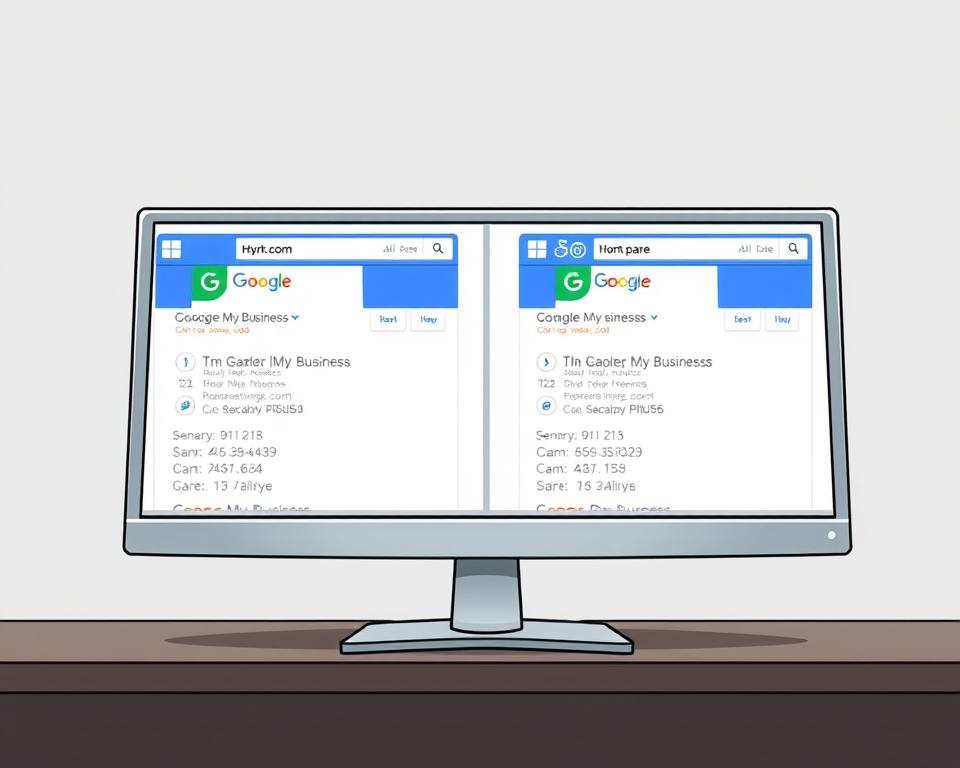
How the Map Pack appears
Also called the Local 3-Pack features a trio of local listings. Google shows these results when it thinks you’re looking for nearby services. It uses Business Profile data to find the best matches.
Clicks, calls & visits: the Map Pack effect
Placement in the Local Pack drives more instant actions than standard organic. Studies by BrightLocal, Neil Patel, and Red Local SEO get stronger click and call volume. Data shows 76% visit a nearby business within a day.
Some benchmarks put non-pack organic CTR near 2.6%. This shows how powerful Map Pack visibility is for foot traffic and calls.
How it differs from regular organic results and paid listings
The Map Pack is different because it uses live Business Profile data and focuses on local relevance. Its visual prominence often exceeds typical organic. Sponsored local ads can also appear, but those are paid.
Placement relies on relevance, distance, and prominence—not just ad spend. It’s not just about ad spend.
Optimizing Your Google Business Profile
Begin with GBP claim and verification. It proves ownership to Google and improves your eligibility for local results. Make sure your profile is always verified and update it if you change ownership.
Complete all profile fields for clarity. Use your real business name and avoid keyword stuffing. Pick precise categories and drop the pin correctly.
List a local line and your site. Add service areas as appropriate. Accurate hours and special hours help avoid user frustration and improve your local SEO.
Keep your formatting consistent. Match address formatting across the web. Avoid duplicate profiles to prevent confusion and ensure Google trusts your data.
Visuals are key. Add fresh photos and clips regularly. Refresh your images regularly to keep your profile active and support your Google My Business optimization efforts.
Create a concise, original description with natural local terms. Choose accurate categories and link to relevant pages on your site. Always respond to reviews to build trust and prominence.
| Task | Why It Matters | Best Practice |
|---|---|---|
| Claim & Verify Profile | Proves ownership, increases visibility | Complete verification; keep status current |
| Accurate NAP | Supports trust and ranking signals | Use consistent address format for location consistency |
| Categories & Description | Helps Google match searches to services | Select precise categories; write a natural local description |
| Hours & Special Hours | Reduces visitor frustration; prevents search errors | Update regularly; include holiday schedules |
| Photos, Videos & Listings | Improves engagement and click-throughs | Post high-quality images, short videos, and product listings |
| Review Management | Builds prominence and local trust | Ask for reviews ethically; reply promptly and professionally |
Key Google Map Pack Ranking Factors
Map Pack placement rests on three pillars. Mastering relevance, distance, and prominence helps you appear more often. This results in more calls and foot traffic.
Relevance: match intent
Relevance checks if your Business Profile matches what users are looking for. Provide comprehensive GBP details. Use accurate categories, service listings, and a clear description.
Use tasteful local modifiers in copy. This helps Google match your listing with searches that match your services.
Name offerings specifically. Keep terminology consistent. This avoids mixed signals that can lower relevance.
Distance: proximity & estimation
Distance measures proximity to the user or centroid. Google may estimate from IP and device data. Proximity heavily impacts “near me” queries.
Confirm correct address and service areas. If you serve nearby neighborhoods, create pages and content for those areas. That supports proximity signals.
Prominence: authority signals
Prominence reflects online/offline reputation. Signals include reviews, links, press, and citations. More good reviews can improve prominence.
Solicit authentic feedback and earn credible links. This could be Chamber of Commerce pages, local news outlets, or industry associations. This increases your perceived prominence.
Keep Name, Address, Phone Consistent
Having consistent Name, Address, and Phone details is key for local search. Google checks your Business Profile against other directories like Yelp and Facebook. Small discrepancies can confuse algorithms.
NAP: why Google cares
It verifies location authenticity. Uniform NAP clarifies signals. That boosts Pack eligibility.
Clean up your listings
Check every citation on sites like Yelp and Facebook. Make sure everything is the same, including suite numbers. Eliminate dupes to prevent dilution.
Citation tracking workflow
Track listings in a sheet or with tools. These tools help you update and report any issues. Refresh data on a cadence.
Checklist: protect local signals
- Use the exact legal business name on all listings.
- Keep address style uniform.
- Standardize phone formatting.
- Claim major directories and niche sites relevant to your industry.
- Maintain a central citation ledger.
Keeping your NAP details consistent and updating your citations regularly boosts your local authority. That supports Pack visibility and discovery.
Customer Reviews and Review Management Strategies
Customer reviews greatly impact how people view a business and its local presence. Positive feedback and thoughtful responses show you value your customers. Review analytics inform strategy.
Counts and averages signal trust. Businesses with many high ratings often rank higher in the Google Map Pack. Consistent, authentic reviews aid Pack entry and actions.
Best practices for requesting reviews without violating policies
Ask happy customers to leave short, specific reviews about their experience. Provide easy review links post-purchase. Use signage to show how to review. Never offer incentives for positive reviews or ask for fake ones; these actions can harm your reputation.
Responding to positive and negative reviews to increase trust
Timely replies are best. Thank reviewers for their kind words and mention specific details when it’s relevant. Handle complaints with empathy and an offline resolution path. Professional speed builds trust and supports GBP.
Keep an eye on your review performance in Business Profile insights. Let insights guide outreach and service fixes. Align your review management with your local SEO strategies to stay competitive and influence the Google Map Pack ranking factors over time.
Strengthening On-Page Local Relevance
Good on-page work makes Google link your site to local searches. Make sure your Name, Address, and Phone (NAP) are the same everywhere. That builds trust in your location.
Embedding Google Maps and showing exact NAP
Embed a map on Contact/About. Match the GBP address exactly. Show complete NAP site-wide.
It synchronizes site and GBP. It supports direction signals.
Using local terms on pages
Make service+city pages. Favor service+location phrases.
Write readable headers and metas. This makes your site more relevant for Google Map Pack and helps users.
Ideas for localized content
Publish staff bios, area news, seasonal promos. Add hours, localized about copy, and testimonials.
Event recaps and partnerships build prominence. They provide timely, useful details.
| On-Page Element | What to Include | Benefit for Local Ranking |
|---|---|---|
| NAP in footer | Exact business name, full street address, local phone number | Improves location consistency and trust with Google |
| Embedded Google Map | Interactive map tied to the same profile address on Contact and About pages | Boosts click-to-direction signals and aligns site with profile |
| Localized service pages | City/neighborhood terms, service details, unique content per area | Targets local queries and aids Google Map Pack ranking factors |
| Local content sections | Staff bios, events, local testimonials, operating hours | Builds relevance and prominence for nearby searches |
| Technical basics | Fast pages, mobile-friendly layout, structured contact markup | Enhances user experience and supports local search signals |
Citations & Directories for Authority
Citations and listings matter for local. They signal location and credibility. Consistent citations enhance presence.
High-value general directories versus niche/local directories
Claim large, reputable directories first. Then, focus on niche and local directories that fit your business. Pick verticals aligned to your industry.
General directories help you reach more people and establish a basic level of authority. Niche directories, on the other hand, bring in targeted traffic that supports your local SEO efforts.
Keep listings consistent & de-duped
Consistency beats raw volume. Match name/phone/address exactly. Tiny differences create confusion.
Scan and resolve dupes. Consolidate and correct errors. That protects rankings and data hygiene.
How citations contribute to prominence and trust
Citations and directory listings help with prominence when they’re on trusted sites. Mentions/links/reviews act as proof points.
Track listings, prioritize key sites, and keep mentions accurate. It supports better map and Pack rankings.
Earning Local Backlinks
Local backlinks are like votes of confidence for nearby businesses. Google’s local algorithms use these links to judge a business’s prominence and trust. Getting strong backlinks from regional publishers or community sites can boost visibility in the Google Map Pack. They complement on-page and citation work.
Begin with a prospect list. Focus on regional media and partners. They host guides and resources. Pitch them with timely angles like community events, case studies, or expert commentary that fit their audience.
Make link-worthy content. Publish guides, local how-tos, data/surveys. Be available for reporter quotes. These quotes often turn into backlinks that strengthen Map Pack prospects and reinforce local SEO strategies.
Use sponsorships and partnerships to build strong local relationships. Sponsor community events and request links. Publish joint resources with link exchange. It combines PR with SEO impact.
Prioritize high-quality, relevant links. Quality outweighs quantity. Track pipeline and outcomes. Consistency compounds authority.
Mobile-Friendliness and Website Performance for Local Users
Local intent is largely mobile. Speedy UX converts on-the-go users. Make your site mobile-friendly and optimized to boost nearby searchers’ actions.
Speed, responsiveness & UX
Fast load matters. Optimize assets and reduce bloat. A responsive design makes it easy to use on phones and tablets.
Make navigation intuitive. Promote tap-to-call and directions. Support accessibility and clarity.
How mobile searches influence proximity and click behavior
Mobile users want quick, local results. They often look for directions or a call. Speed plus accurate NAP boosts actions.
Mobile searches focus on being close to the user. Highlight immediacy cues.
Tech tasks that support local
Schedule tech checkups. Ensure schema and security are correct. Keep indexation clean with sitemaps/fixes.
Continue performance tuning. Minify assets, compress images, leverage CDNs. Add Google Maps for quick directions and ensure your contact details match your Business Profile.
This improves UX while reinforcing locality. They enhance proximity and relevance cues.
Service Areas & Proximity Signals
Defined coverage areas support ranking. Make sure your Google Business Profile matches the cities and neighborhoods you serve. Also, create location-specific pages and content to show consistent information everywhere.
Configure service areas correctly
Enter only service areas you actually serve. List cities, ZIP codes, or neighborhoods you regularly serve. Stay conservative to prevent confusion.
Sync profile, site, and citations. This improves matching to nearby searches.
Build pages for each area
Build localized pages with specific details. Employ service+location phrasing. This tactic improves relevance for local queries and boosts your chances of appearing in maps and organic listings.
Make area pages easy to find. It streamlines navigation and crawling. It supports site-wide local signals.
Searcher location & IP signals
Google uses device or IP-based location. Without place names, proximity can dominate.
Reinforce proximity with settings/content/citations. That creates a clear local footprint. It boosts exposure to nearby users.
Tracking, Testing, Improving
Establish your GBP starting metrics. Review impressions, clicks, calls, directions, and queries. Set targets and test plans from baselines.
Essential metrics show progress. Watch Map Pack impressions, click-through rate, website visits, phone calls, and direction requests. Also, track review velocity, average rating, citation volume, and local backlinks. Review weekly to catch trends.
Combine platform insights. GBP yields visibility data. Google Analytics links website behavior to Map Pack clicks. Track local SERP positions with tools.
Listing management platforms like ReviewTrackers help with reviews and citations. GSC surfaces indexing and link info. This stack creates comprehensive visibility.
Experiment methodically. Iterate on profile, content, and reviews. Limit variables to isolate effects.
Document changes and outcomes. Log date/action/result for each test. Iterative, logged testing works best.
Make a monthly report that shows your wins, failures, and plans. Chart key metrics. Let insights guide strategy and tracking.
Conclusion
Sustained local SEO drives Pack gains. Make sure your Google Business Profile is complete and up-to-date. Also, keep your business information the same everywhere online.
Fresh media helps. It reinforces credibility and relevance.
Reviews and fast replies help you stand out. Citations and local links add strength. Back it up with local pages, mobile performance, and proper service areas.
First, get GBP verified. Clean up citations and grow reviews. Watch Pack impressions and calls.
If you need help, Marketing1on1 can assist. They understand local ranking signals. They can drive more clicks, calls, and visits.